
Published July 3, 2026
The Summer AC Emergency: What to Do When Your Air Conditioner Freezes Solid

The Summer AC Emergency: What to Do When Your Air Conditioner Freezes Solid
Imagine walking through the door after a long, exhausting workday, looking forward to escaping the oppressive summer humidity. You step inside, but instead of the refreshing blast of cool air you expect, the house feels heavy, thick, and uncomfortably warm. You check your thermostat—the digital screen might be reading a crisp target temperature, but the ambient room temperature is climbing rapidly into the 80s. Even more confusing, your modern smart thermostat may have completely lost its Wi-Fi connection or gone entirely blank earlier in the afternoon.
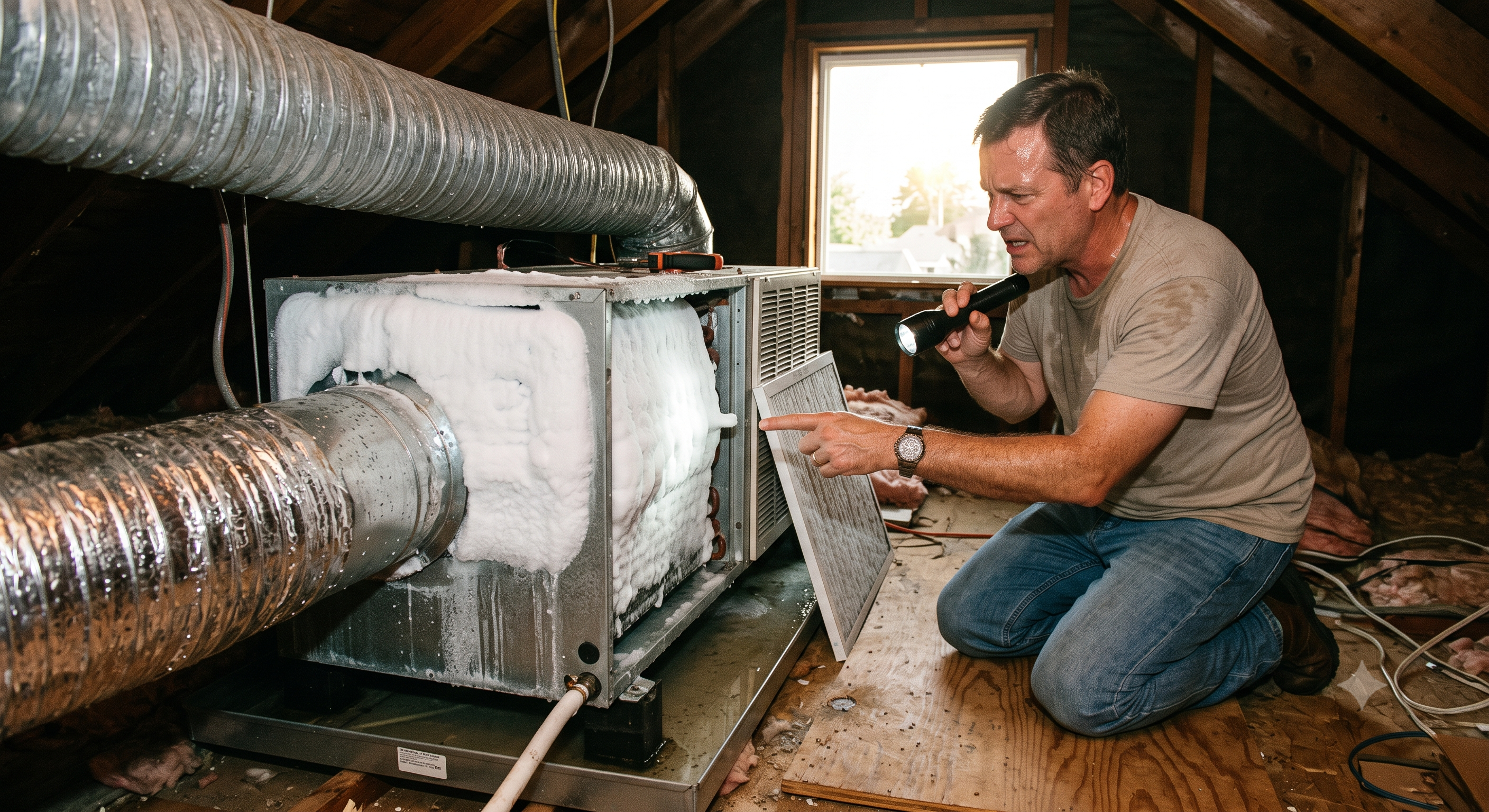
This frustrating scenario plays out in thousands of households every summer. When an air conditioner blows warm air despite the outdoor condenser unit running normally, the system is usually suffering from a classic thermal breakdown: the indoor evaporator coil has frozen into a solid block of ice. Compounding this challenge, local power companies frequently launch "peak energy savings events" on these exact same scorching days, creating a perfect storm for residential HVAC systems. Understanding how a frozen system behaves and how to manage your airflow when the utility grid cuts back power is critical to saving your equipment and keeping your family comfortable.
The Physics of a Frozen System: Airflow vs. Cold
When an air conditioner fails to keep up with intense heatwaves, many homeowners automatically assume the outdoor compressor unit is broken. However, central heating and cooling rely entirely on a delicate equilibrium between your indoor equipment and your ductwork layout. An air conditioner does not technically manufacture cold air; it extracts heat energy from your living space.
Your system utilizes a high-efficiency blower fan to draw warm air from your home and push it across an incredibly cold indoor evaporator coil, which is packed with liquid refrigerant. As the indoor air passes over the coil, the heat is absorbed by the refrigerant and carried outside, leaving cool air to flow back through your supply vents. If the volume of air flowing across that indoor coil drops below a specific threshold, the heat exchange fails. Deprived of warm household air to balance its extreme temperature, the moisture that your AC strips from the atmosphere instantly drops past 32°F and crystallizes. Within hours, a small layer of frost escalates into a solid wall of ice, choking off your ventilation system entirely.
The Safety Domino Effect: Blank Screens and Offline Thermostats
One of the most confusing symptoms of a frozen AC is a sudden electronic blackout. Homeowners often find their smart or Wi-Fi-enabled thermostats completely unresponsive or disconnected from their home networks right when the house begins to overheat. This isn't a digital glitch—it's a direct result of an HVAC safety mechanism engineered to prevent water damage.
When an evaporator coil turns into a block of ice, that ice eventually begins to shed water. Under normal conditions, condensation drips neatly into a primary drain line and is carried safely away. But when a massive sheet of ice undergoes a heavy thaw, the water flow can easily overwhelm the system's plumbing or back up due to dust and debris.
To protect your home's ceilings, framing, and drywall from catastrophic internal water damage, HVAC installers place an emergency secondary drain pan under the indoor unit equipped with a water-activated float switch. When water rises in this safety pan, the float rises and instantly interrupts the 24V low-voltage control circuit that delivers power to your wall thermostat. By instantly cutting power, the safety switch shuts down the entire cooling system to stop more ice from melting. Once the backup water slowly drains away, the circuit closes, power is restored, and your smart thermostat finally boots back up.
When the Grid Intervenes: Navigating Power Company Energy Events
To make matters more complex, the hottest days of the year are exactly when electrical utility providers experience extreme strain on the regional power grid. To avoid blackouts, many power companies implement Peak Demand, Load Management, or Eco-Savings Events during peak afternoon hours (typically between 1:00 PM and 6:00 PM).
If you have enrolled in a smart thermostat rewards program or have a utility-managed switch attached to your outdoor unit, the power company will remotely intervene during these events. They may automatically raise your target thermostat temperature by 2 to 4 degrees, or cycle your outdoor compressor off for short intervals to conserve grid energy. While this protects the infrastructure, it means an HVAC system that is already struggling or partially frozen will lose significant ground. If the house temperature climbs too high during a grid event, the system will be forced to run continuously for hours afterward to recover, which dramatically increases the risk of a total system freeze-up.
The Extreme Weather Lockdown: How to Protect Your Airflow Today
If your system has recently thawed or you are trying to prevent a catastrophic freeze during a peak summer heat wave, you need to manage your system's airflow defensively. Treat your home to an immediate operational check using these three steps:
1. Inspect and Remove Restricted Air Filters
A restricted air filter is the absolute leading cause of an ice-blocked evaporator coil. High-efficiency pleated air filters (such as heavy allergen-reduction or high-MERV filters) are exceptional at trapping dust, but they also severely restrict the volume of air moving through your HVAC unit. When temperatures climb, your system requires maximum, uninhibited airflow to stay above freezing. If your air filter is anything less than immaculate, or if you just washed a reusable filter and it is still damp, remove it entirely during the heatwave. Running your air conditioner with no filter for 24 to 48 hours is perfectly safe for the system and instantly eliminates your largest airflow bottleneck.
2. Switch Your Thermostat Fan to "ON" Instead of "AUTO"
During extreme summer heat or a power company demand event, navigate your thermostat menu and switch the fan setting from AUTO to ON. While the AUTO setting only runs your indoor blower fan when the outdoor unit is actively compressing refrigerant, the ON setting locks your indoor fan into a continuous, 100% runtime cycle. Pushing a non-stop, steady stream of warm air across that indoor coil ensures that any early frost formations are continuously melted away, preventing a solid block of ice from establishing a foothold.
3. Open Every Single Vent and Door
A major home maintenance myth dictates that closing supply vents in guest rooms or unused areas of the house saves money. In reality, modern central heat pumps and air conditioners are engineered around highly specific volumes of air and static pressure. Closing vents or slamming doors to specific rooms—especially rooms fed by separate ductwork trunks—bottlenecks the system. The trapped air super-cools within the blocked duct lines, driving the main indoor coil temperature below 32°F. Keep all interior doors and registers wide open so the system can move air freely back to its central return vents.
Frequently Asked Questions (FAQ)
-
Q: How long does it take for a frozen AC coil to completely melt?
-
A: A completely frozen evaporator coil can take anywhere from 2 to 4 hours—and sometimes up to a full day—to completely thaw. To speed up this process safely, turn the cooling system entirely OFF at the thermostat and set the fan option to ON. Never pick at the ice with tools, as you can easily puncture the delicate copper or aluminum lines.
-
-
Q: Why do my HVAC ducts sweat or drip water during a freeze?
-
A: When an indoor coil freezes solid, the air trapped directly inside the ductwork drops to extreme, near-freezing temperatures. When hot, humid ambient air in an unconditioned space (like an attic or crawlspace) comes into contact with the outside of those super-cooled metal or flexible ducts, the air reaches its dew point instantly, causing heavy condensation or "sweating."
-
-
Q: What should I do if my smart thermostat enters a utility savings event?
-
A: If your home is already struggling to maintain cool temperatures, you can typically opt-out of the peak energy event directly through your thermostat's smartphone app or by manually adjusting the physical dial. Pre-cooling your home by dropping the temperature a few degrees early in the morning before the event begins is an excellent way to prepare for these grid cutbacks.
-
If you need help finding a quality HVAC cpmpany, give Scott Fogleman a call 434-941-8847

Scott Fogleman
Broker | GRI | CRS | New Home Team | Scott Fogleman | eXp Realty Virginia
or another way